
AI & Automation
MCP, A2A and the New Enterprise AI Integration Layer: What Technology Leaders Need to Know
Updated 20 September 2026
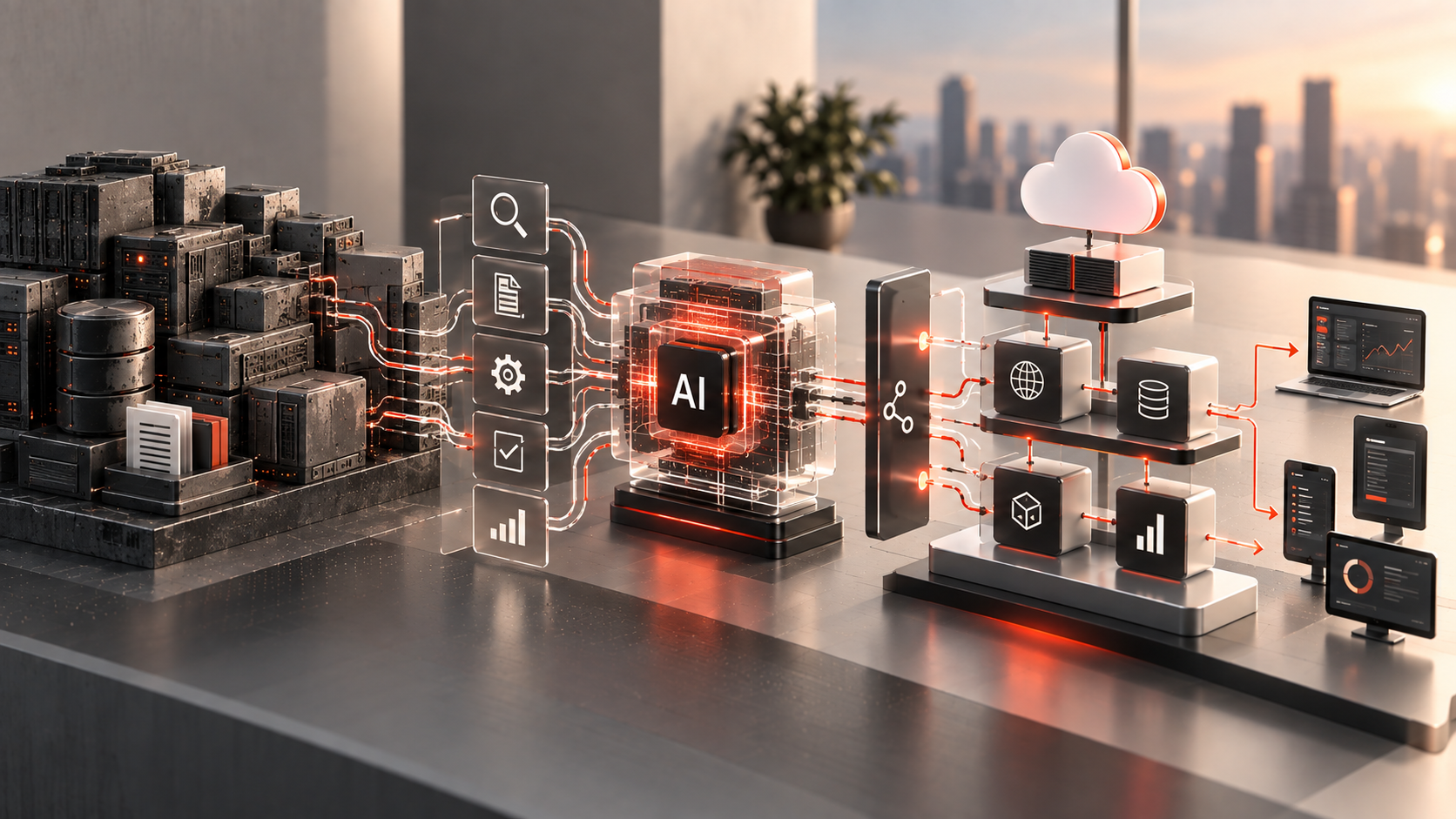
MCP, A2A and the New Enterprise AI Integration Layer: What Technology Leaders Need to Know
Enterprise AI has an integration problem.
A capable model can reason about a task, but useful business work usually requires more than reasoning. The system may need to retrieve a customer record, search internal documentation, query a database, create a ticket, invoke an API, interact with another specialized agent, or update an enterprise application.
Until recently, much of that connectivity was built independently for each AI application.
That is beginning to change.
Model Context Protocol (MCP), Agent2Agent (A2A), and related interoperability approaches are creating a more standardized layer between AI agents, tools, applications, data sources, and other agents.
For technology leaders, this matters for a reason bigger than protocol selection.
The enterprise AI stack is beginning to acquire an integration layer specifically designed for agents.
What Problem Is MCP Trying to Solve?
An AI model by itself does not automatically know how to interact with an organization's software.
Imagine an internal AI assistant that needs to:
search company documents;
retrieve CRM information;
query a database;
inspect a Git repository;
create a project-management task;
call an internal API.
Without a common integration pattern, developers may create separate custom connectors for each combination of AI application and enterprise system.
As the number of applications grows, the integration matrix becomes difficult to maintain.
MCP addresses this problem by providing a standardized way for AI applications to discover and use external capabilities and context.
Instead of teaching every AI application a completely different integration method, an MCP server can expose approved resources and tools through a consistent protocol.
Conceptually:
AI Client → MCP → Tools, Applications and Data
That does not eliminate integration engineering.
It standardizes part of the boundary.
MCP Is More Than a Connector Format
It is tempting to think of MCP as simply another API specification.
The architectural implications are broader.
An MCP server can expose capabilities that an AI client can discover and use. This makes integrations more portable and potentially more reusable across different AI applications.
For example, an enterprise might create controlled MCP access to:
customer records;
internal search;
order information;
analytics;
project systems;
cloud operations;
document repositories.
Different approved AI applications could then interact with those capabilities without every team inventing an entirely new integration mechanism.
The potential benefit is not simply developer convenience.
It is architectural reuse.
Then What Is A2A?
MCP primarily addresses the relationship between an AI application and external tools or context.
Another problem appears when multiple agents need to work together.
Consider an enterprise workflow containing:
a research agent;
a customer-data agent;
a pricing agent;
a compliance agent;
an execution agent.
These systems need a way to discover capabilities, exchange information, coordinate work, and understand task state.
That is the problem space addressed by agent-to-agent interoperability approaches such as A2A.
A simplified distinction is:
MCP: agent-to-tool and agent-to-context connectivity.
A2A: agent-to-agent communication and coordination.
The boundaries can evolve, and enterprises should avoid treating today's protocol landscape as permanently settled. But the architectural distinction is useful.
One helps agents reach capabilities.
The other helps agents collaborate.
Why Enterprises Should Care Now
The importance of interoperability grows with the number of AI systems an organization deploys.
A company with one internal assistant can tolerate custom integrations.
A company with dozens of agents cannot sustainably build every connection from scratch.
Imagine ten agents and twenty enterprise tools.
If every agent implements its own proprietary connection to every system, integration complexity increases quickly.
Standardized interfaces can reduce some of that duplication.
This is similar to earlier shifts in enterprise software.
REST APIs did not remove the need for integration engineering.
OAuth did not remove identity engineering.
Containers did not remove infrastructure engineering.
Standards made it easier to create repeatable architectural patterns.
MCP and agent interoperability standards may play a similar role for agentic systems.
The Real Enterprise Question Is Governance
Standard connectivity creates opportunity.
It also creates risk.
An agent that can discover tools may potentially reach:
customer information;
financial systems;
internal documents;
source code;
cloud infrastructure;
communication systems.
That makes an MCP server more than a technical convenience.
It becomes a potential enterprise access boundary.
Organizations therefore need to answer:
Who can connect?
Which agent is making the request?
Which user initiated the task?
Which tools can that agent see?
Which operations can it execute?
Which credentials are being used?
What data can pass through the connection?
How is activity recorded?
What happens when the request violates policy?
This is why recent enterprise implementations are emphasizing gateways and governance rather than simply connectivity.
Why MCP Gateways Are Emerging
A gateway places a control layer between AI clients and enterprise capabilities.
Conceptually:
AI Agent → MCP Gateway → Approved MCP Servers → Enterprise Systems
The gateway can potentially enforce:
authentication;
authorization;
tool-level permissions;
credential management;
rate limits;
policy rules;
logging;
monitoring;
auditability.
Oracle's September 2026 MCP Gateway announcement illustrates this direction, emphasizing centralized identity, policy, credentials, enforcement and observability.
Microsoft has similarly discussed extending API-management concepts into AI gateways that govern MCP servers and agent-to-tool interactions.
This is an important architectural signal.
Enterprise AI integration is beginning to look less like a collection of experimental plugins and more like managed infrastructure.
Identity Becomes Critical
Human employees usually have established enterprise identities.
Applications use service accounts, API keys, workload identities or other machine credentials.
AI agents complicate this model.
An agent may act:
on behalf of a specific employee;
on behalf of a department;
as an independent service identity;
as part of another agent's workflow.
Those distinctions matter.
If an agent modifies a customer record, the enterprise should be able to determine:
which agent acted;
which user or workflow authorized it;
which identity accessed the underlying system;
which policy permitted the action.
Shared credentials make that harder.
As agent adoption grows, identity architecture will need to treat agents as first-class actors rather than invisible software processes.
Discovery Must Not Mean Unlimited Access
One attractive feature of agent interoperability is dynamic discovery.
An agent can learn which capabilities are available rather than having every operation hard-coded.
But discoverability should not imply universal visibility.
A marketing agent does not need payroll tools.
A customer-service agent should not automatically discover infrastructure-management functions.
A research assistant should not receive write access to financial systems.
Enterprise implementations therefore need curated capability exposure.
The question is not:
“What tools exist?”
It is:
“What tools should this particular agent be allowed to discover and use for this particular task?”
That is a much safer design principle.
Tool Descriptions Become Part of the Security Model
Agents often decide which capability to invoke based on descriptions of available tools.
That makes tool design unusually important.
A vague operation such as:
manageCustomer()
provides less architectural clarity than narrow operations such as:
getCustomerProfile()
createCustomerNote()
requestAccountClosure()
The narrower interfaces allow different authorization policies to be applied to different actions.
Read operations can be treated differently from consequential writes.
High-risk actions can require human approval.
The protocol may standardize connectivity, but secure tool design remains the responsibility of the application architecture.
MCP Does Not Replace APIs
Enterprises should not interpret MCP as the end of REST, GraphQL, event systems, queues, or traditional APIs.
MCP frequently sits above existing capabilities.
An enterprise application might already expose a REST endpoint.
An MCP server can make an approved operation available to an AI client while the underlying implementation continues to use the existing API.
Conceptually:
Agent → MCP Interface → Integration Service → Existing API → Business Application
This is important because organizations do not need to rebuild their entire software estate to participate in agentic architecture.
Existing APIs remain valuable.
MCP can become another interface layer designed for AI consumers.
A2A Introduces Multi-Agent Architecture Questions
Once agents begin communicating with other agents, additional questions appear.
How does an agent discover another agent?
How are capabilities advertised?
How is identity verified?
How is task state represented?
How are long-running tasks handled?
What happens if one agent fails?
How is responsibility traced across a chain of agents?
How does the organization prevent an agent from delegating work beyond its authority?
Multi-agent architecture therefore requires more than message passing.
It needs trust boundaries.
If Agent A is authorized to read a record but not delete it, delegating the task to Agent B should not magically create deletion authority.
Authorization needs to survive delegation.
Observability Must Cross Agent Boundaries
Traditional application monitoring often follows a request through services.
Multi-agent workflows need something similar.
Suppose:
Agent A receives a user request.
Agent A delegates research to Agent B.
Agent B queries two tools.
Agent A sends the result to Agent C.
Agent C proposes an action.
A human approves it.
Agent D executes the action.
When something goes wrong, operators need to reconstruct that chain.
Useful observability should capture:
initiating user or event;
participating agents;
models used;
tools called;
data accessed;
delegation relationships;
authorization decisions;
approvals;
latency;
costs;
final outcome.
This is why agent observability is emerging as its own enterprise concern.
Avoid Building a Protocol Strategy Around Hype
Interoperability standards are developing quickly.
Technology leaders should resist two extremes.
The first is ignoring them completely and continuing to create proprietary integrations for every agent.
The second is redesigning the entire enterprise architecture around a protocol simply because it is receiving attention.
A pragmatic approach is better.
Identify where standardized interfaces genuinely reduce duplication.
Keep business logic behind stable application boundaries.
Avoid coupling core enterprise systems directly to one model vendor.
Place security and authorization outside model prompts.
Create adapters where necessary.
Design so protocols can evolve without forcing a rewrite of the underlying business application.
A Practical Enterprise Adoption Framework
Organizations exploring MCP and agent interoperability can begin with six steps.
1. Inventory Current Agent Integrations
Document which AI applications currently connect to which enterprise systems.
Look for duplicated connectors and inconsistent access patterns.
2. Identify Reusable Capabilities
Find functions multiple agents may need, such as customer lookup, document search or ticket creation.
These are stronger candidates for standardized exposure.
3. Define Identity and Permission Boundaries
Decide which agents can access each capability and under whose authority they operate.
4. Introduce a Governance Layer
Avoid allowing uncontrolled direct connections between every agent and every MCP server.
Evaluate gateway patterns for policy enforcement, credentials and observability.
5. Instrument Everything
Capture tool calls, identity, authorization, failures, latency and cost.
6. Start With a Bounded Workflow
Do not make the entire enterprise an MCP experiment.
Choose one useful workflow, establish the architecture and expand after operational behavior is understood.
Where Noviqon Solutions Fits
Noviqon Solutions designs AI automation and AI-agent systems alongside full-stack applications and cloud infrastructure.
As agent interoperability matures, those areas increasingly intersect. Useful agents need controlled access to APIs, applications, databases and business workflows. Production implementations also need identity, deployment architecture, monitoring and integration boundaries.
Organizations evaluating MCP or multi-agent architectures should therefore think beyond the protocol itself.
The protocol connects components.
The surrounding architecture determines whether the resulting system is secure, maintainable and useful.
The Enterprise AI Stack Is Becoming Modular
The next phase of enterprise AI will not be defined only by which model an organization chooses.
It will increasingly depend on how models, agents, tools, applications, data and other agents work together.
MCP and A2A are important because they point toward a more modular AI architecture.
But standardization does not eliminate engineering.
It changes where engineering effort belongs.
Less time building one-off connectivity.
More time designing permissions, reusable capabilities, governance, observability and business workflows.
That is the shift technology leaders should be watching.
Build the Integration Layer Around Your AI Strategy
Noviqon Solutions designs AI automation, AI-agent workflows, full-stack platforms and cloud systems for organizations moving from isolated AI experiments toward production software.
If your organization is evaluating MCP, agent interoperability, enterprise APIs or multi-agent workflows, Noviqon can help assess the existing architecture and design controlled integration patterns around the systems your business already uses.