
AI & Automation
How to Secure Enterprise AI Agents Before Production: An Implementation Framework
Updated 17 September 2026
How to Secure Enterprise AI Agents Before Production: An Implementation Framework
A chatbot that gives a bad answer creates a quality problem.
An AI agent that has permission to update a CRM, send an email, modify a database, execute code, or initiate a business workflow can create an operational problem.
That distinction is becoming increasingly important as enterprise AI moves from assistance toward execution.
In August 2026, OpenAI reported that enterprise use is becoming more agentic and that agents are spreading beyond software engineering into other areas of knowledge work. NIST, meanwhile, has been developing initiatives around AI-agent security, identity, authorization, and interoperability. Microsoft has also documented work to secure agents operating inside its own enterprise environment.
The direction is clear: businesses are beginning to give AI systems more capability.
Security architecture needs to evolve with that capability.
The goal is not to eliminate autonomy. If every operation requires manual intervention, much of the value of an agent disappears. But unrestricted autonomy creates the opposite problem.
Production AI-agent architecture therefore needs a middle ground: enough authority to complete useful work, but enough control to prevent one mistaken, manipulated, or compromised agent from having unlimited impact.
Here is what that architecture should address.
Why AI Agents Change the Security Model
Traditional generative-AI applications often follow a relatively simple pattern:
User sends input → model generates output → user decides what to do.
An agent introduces additional steps.
User or event triggers agent → agent reasons about task → agent selects tools → agent retrieves information → agent performs actions → agent evaluates results → agent may repeat the process.
The model is no longer only producing information.
It may be operating software.
That means an AI-agent security model must consider not only the model itself but also:
identity;
authentication;
authorization;
connected tools;
APIs;
credentials;
retrieved data;
memory;
external content;
generated commands;
human approvals;
execution environments;
monitoring;
audit trails.
The attack surface expands because the system has more ways to affect its environment.
Start With the Agent's Authority, Not Its Intelligence
Teams naturally spend significant time choosing models.
For security, a more important initial question is:
What is this agent allowed to do?
Imagine an AI sales-operations agent.
It might need to:
read CRM records;
summarize account history;
identify missing information;
draft follow-up messages;
update certain CRM fields;
schedule tasks.
Does it also need permission to delete accounts?
Export the entire customer database?
Change administrator settings?
Send any message to any external address?
Probably not.
An agent should receive the minimum authority necessary to complete its intended role.
This is the familiar cybersecurity principle of least privilege applied to agentic systems.
NIST has specifically highlighted identity and authorization as important issues for AI agents, while OWASP's AI Agent Security guidance recommends narrowly scoped tool permissions rather than unrestricted access.
The principle is simple:
Capability should be intentional, scoped, and enforceable.
1. Give Every Agent a Defined Identity
Production systems should know which agent is taking an action.
Avoid architectures in which multiple agents silently operate through one broadly privileged shared account whenever more granular controls are practical.
A stronger model distinguishes between:
the human initiating a workflow;
the AI agent performing work;
the service or application being accessed;
the specific permissions delegated for that task.
This improves both access control and auditability.
When something happens, the organization should be able to determine:
Who initiated the task?
Which agent executed it?
Which credentials were used?
Which resource was accessed?
Which action was requested?
Was human approval required?
What happened afterward?
NIST's 2026 work on agent identity and authorization reflects exactly this emerging challenge: autonomous software requires meaningful identification and authorization mechanisms when it interacts with enterprise resources.
2. Apply Least Privilege to Every Tool
Tool access is where an AI agent becomes operationally powerful.
A model may have access to tools for:
searching documents;
reading databases;
writing records;
sending messages;
creating tickets;
generating invoices;
executing code;
managing cloud resources.
Do not treat all tools as equally risky.
Reading a public product catalog is fundamentally different from deleting production data.
A useful architecture separates permissions by both tool and operation.
For example:
CRM:
Read contact: allowed
Update approved fields: allowed
Export database: blocked
Delete contact: approval required
Email:
Search mailbox: allowed within defined scope
Draft email: allowed
Send internal email: conditional
Send external bulk email: blocked or approval required
Database:
Read approved views: allowed
Insert predefined record: conditional
Change schema: blocked
Delete production table: blocked
OWASP recommends enforcing these controls at the authorization layer rather than relying only on instructions inside prompts.
That distinction is critical.
“Never delete customer data” written in a system prompt is guidance to a probabilistic model.
A backend permission that makes deletion impossible is a security control.
Use the second for consequential boundaries.
3. Separate Reasoning From Execution
A useful architectural pattern is to prevent the model's proposed action from automatically becoming an executed action.
Instead:
Agent proposes action → policy layer validates action → authorization layer checks permission → optional human approval → execution service performs action.
This separation creates several opportunities to stop unsafe behavior.
The system can validate:
whether the requested tool is allowed;
whether the parameters match an expected schema;
whether the user has authority;
whether the agent has authority;
whether the operation exceeds a risk threshold;
whether human confirmation is required.
The model remains responsible for reasoning.
Deterministic software remains responsible for enforcing boundaries.
This is one of the most important design principles for production agentic systems.
4. Treat External Content as Untrusted Input
Agents frequently consume information from outside the model's controlled environment.
That can include:
websites;
emails;
uploaded documents;
support tickets;
CRM notes;
API responses;
retrieved knowledge;
messages from other agents.
This creates a significant problem: instructions can exist inside the data the agent is processing.
An email might contain text designed to manipulate the agent.
A webpage might contain hidden instructions.
A document might attempt to convince an agent to reveal data or invoke a tool.
This class of problem is commonly associated with prompt injection.
The defensive principle should resemble traditional application security: external content is data, not trusted authority.
Organizations should combine measures such as:
input validation;
content isolation;
strict tool permissions;
structured tool interfaces;
authorization checks outside the model;
output validation;
restricted execution environments;
monitoring.
No single prompt can provide a complete security boundary.
5. Protect Agent Memory
Memory can make an agent dramatically more useful.
It can also create persistent risk.
If an agent remembers customer preferences, previous tasks, internal context, or workflow history, teams need to determine:
What can enter memory?
How long is it retained?
Who can retrieve it?
Can one user influence another user's memory?
Can external content become trusted persistent context?
Does memory contain credentials or sensitive information?
Can users correct or delete it?
Memory should be treated as a data store, not as an invisible extension of the prompt.
Appropriate controls may include:
user and tenant isolation;
validation before persistence;
encryption;
retention policies;
data classification;
redaction;
access controls;
provenance metadata.
A poisoned memory can influence future behavior long after the original interaction has ended.
6. Use Risk-Tiered Human Approval
“Human in the loop” sounds safe, but badly designed approval systems create their own problems.
If a human must approve every harmless action, reviewers become overloaded.
Eventually, approvals become mechanical.
If humans approve nothing, the agent may have excessive autonomy.
AWS's Agentic AI Lens recommends a risk-tiered approach: human review should focus on operations where judgment actually matters.
A practical model might classify actions like this:
Low risk: Read an approved knowledge base.
Medium risk: Update a reversible internal record.
High risk: Send an external communication or execute code.
Critical: Transfer funds, permanently delete data, change privileged access, or perform another irreversible security-sensitive operation.
The exact classification depends on the business.
The important part is that autonomy should reflect consequence.
A customer-support agent might autonomously retrieve an order status but require approval before issuing a large refund.
A development agent might run tests automatically but require approval before deploying to production.
An operations agent might create a purchase request but not authorize payment.
Good human oversight is selective rather than universal.
7. Put Hard Limits Around Agent Behavior
An agent can fail without behaving maliciously.
It may loop.
It may retry the same failing action repeatedly.
It may call an expensive API too many times.
It may generate excessive cloud usage.
It may keep delegating tasks.
Production architecture should therefore include operational limits.
Useful controls include:
maximum execution time;
maximum tool calls;
retry limits;
token budgets;
cost thresholds;
rate limits;
recursion limits;
transaction limits;
restricted network access;
sandboxing for code execution.
These are not glamorous AI features.
They are exactly the kinds of controls that make software dependable.
8. Log Decisions and Actions, Not Just Conversations
Traditional chatbot logging often focuses on prompts and responses.
That is insufficient for an agent.
Organizations need visibility into actions.
Depending on the sensitivity of the workflow, useful audit information can include:
initiating user;
agent identity;
task identifier;
model/version;
tools requested;
tools executed;
authorization results;
data resources accessed;
approval events;
failures;
retries;
final outcome.
Logging also requires restraint.
Credentials, sensitive personal information, secrets, or unnecessary private data should not simply be dumped into logs.
The objective is useful observability, not indiscriminate collection.
9. Design a Kill Switch Before You Need One
Every sufficiently capable agent should have a defined containment mechanism.
If unexpected behavior occurs, teams should be able to:
stop execution;
revoke credentials;
disable specific tools;
isolate the agent;
terminate active tasks;
block external communication;
preserve relevant audit evidence.
Do not wait for an incident to determine how to disable an autonomous workflow.
Containment should be part of deployment architecture.
10. Test the Agent as an Adversary Would
Normal functional testing asks:
“Can the agent complete the task?”
Security testing asks:
“What else can the agent be made to do?”
Before production, teams should test scenarios involving:
malicious documents;
prompt injection;
unexpected tool parameters;
attempts to access unauthorized data;
privilege escalation;
compromised retrieved content;
memory poisoning;
repeated tool loops;
malformed API responses;
unavailable approval services;
attempts to bypass human review.
Testing should also continue after meaningful changes.
A new model, prompt, tool, integration, memory system, retrieval source, or permission can alter the security characteristics of the application.
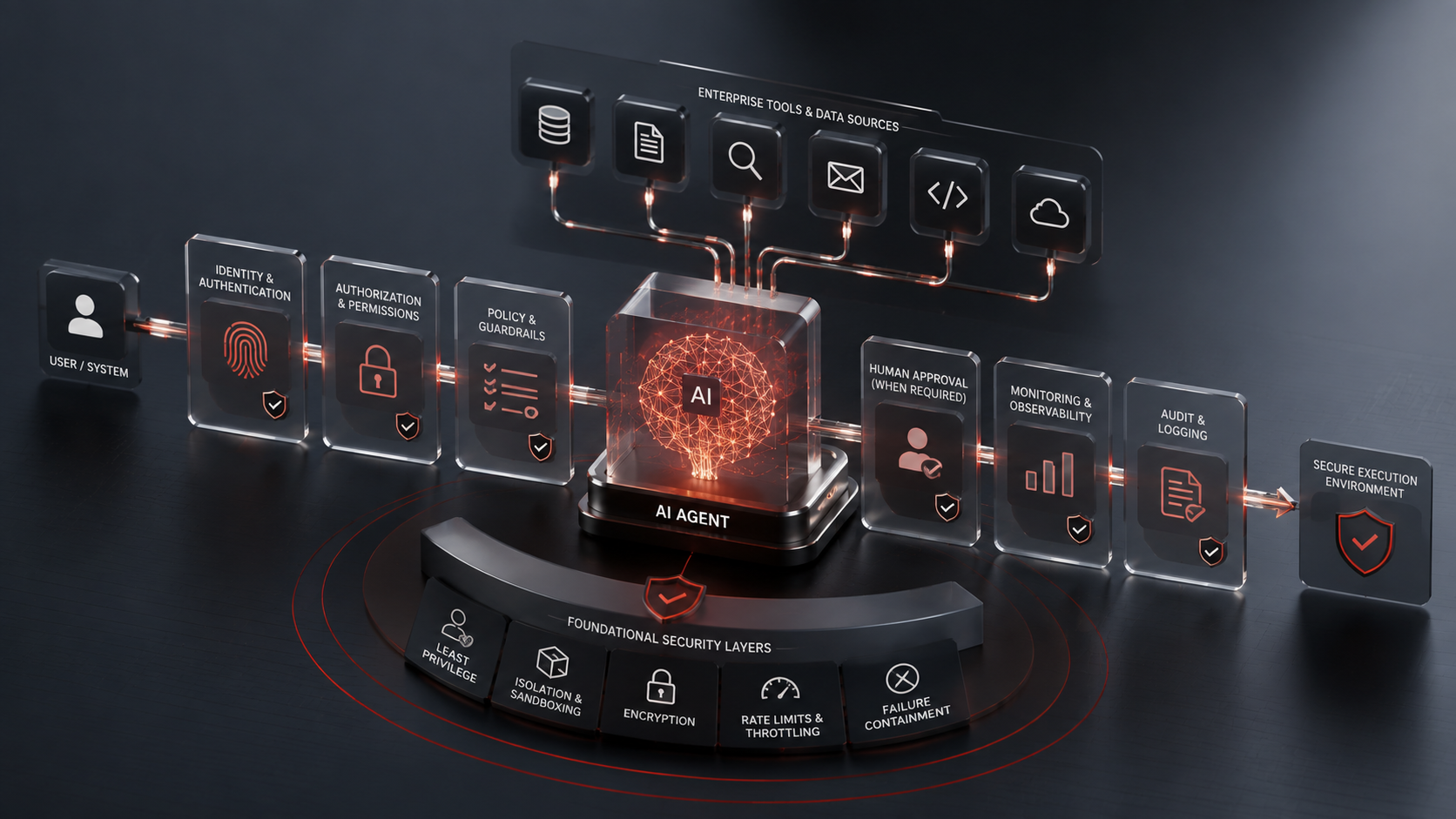
Build the Security Architecture in Layers
No single control is sufficient.
A production architecture can be thought of as multiple defensive layers:
Layer 1 — Identity
Know which user, service, and agent are involved.
Layer 2 — Authorization
Limit what each identity can access and perform.
Layer 3 — Tool control
Expose only necessary tools with tightly defined operations.
Layer 4 — Input protection
Treat retrieved and external content as potentially hostile.
Layer 5 — Policy enforcement
Validate proposed actions before execution.
Layer 6 — Human oversight
Require approval when consequences justify it.
Layer 7 — Execution isolation
Sandbox risky operations and limit network or system access.
Layer 8 — Observability
Record enough information to understand behavior and investigate incidents.
Layer 9 — Containment
Provide mechanisms to stop or revoke an agent rapidly.
Layer 10 — Continuous evaluation
Retest the system as models, tools, prompts, and workflows evolve.
Security comes from the combination.
A Production Readiness Checklist
Before allowing an enterprise agent to perform real actions, teams should be able to answer these questions confidently:
Identity
Does the agent have an identifiable runtime identity?
Can actions be traced to the initiating user or service?
Permissions
Does the agent have only the access required for its role?
Are high-risk operations blocked or separately authorized?
Tools
Are tool inputs validated?
Are sensitive operations enforced by backend controls rather than prompts?
Data
Is external content treated as untrusted?
Is memory isolated appropriately?
Are sensitive data and credentials protected?
Oversight
Are high-impact actions reviewed?
Can reviewers understand what they are approving?
Execution
Are code and other dangerous operations sandboxed?
Are retries, loops, cost, and execution duration bounded?
Monitoring
Can teams see what tools the agent used and what happened?
Are unusual behaviors detectable?
Containment
Can credentials and tool access be revoked quickly?
Can active agent execution be stopped?
Testing
Has the system undergone adversarial testing?
Will it be retested after significant changes?
If several answers are “no,” the agent may still be an impressive prototype.
It is not necessarily ready for production.
Secure Autonomy Is the Product
The enterprise AI conversation is moving past whether models can generate useful answers.
The harder question is whether organizations can safely allow software agents to act.
That requires a different engineering mindset.
The model is one component.
Identity determines who the agent is.
Authorization determines what it can do.
Tool design determines how it interacts with systems.
Policy determines which actions are permitted.
Humans govern consequential exceptions.
Monitoring reveals what actually happened.
Containment limits damage when something goes wrong.
When these elements are designed together, businesses do not have to choose between useful automation and responsible control.
They can build autonomy with boundaries.
And as AI agents move deeper into real business operations, those boundaries may become one of the most important differences between an interesting demonstration and an enterprise system that can actually be trusted.